

I Said Goodbye - The Things We All Know but Leave Unspoken
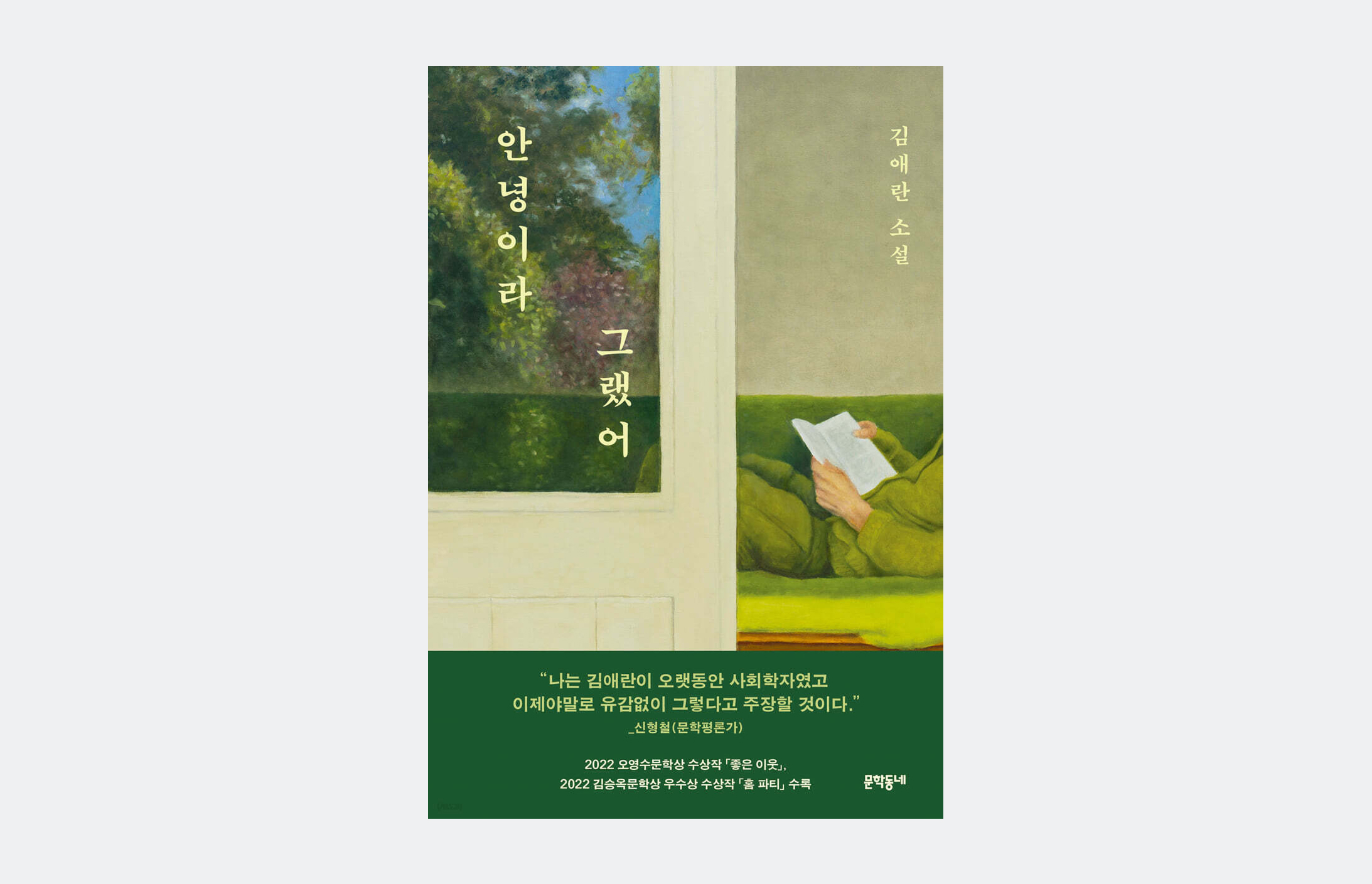
A few months ago, I picked up Kim Aeran’s I Said Goodbye, which had been getting quite a bit of attention at the time, and gave it a read. I had been looking for a novel to read after a long break from fiction, and came across this book while browsing through some of the novels that had been popular recently. It was also how I first discovered Kim Aeran as a writer. The book is a collection of several short stories, and I felt that each story conveyed the ideas and emotions the author wanted to express quite well. In this post, I’ll share some of my thoughts and reflections on each story.
Home Party
Seong-min invites Iyeon to a home party at the house of a business owner he knows. Most of the guests are relatively well-established people of a certain age, and as you listen to their conversations, you can sense how they subtly flaunt their social status while speaking to Iyeon, who is younger and less well-off, with a tone of pity. The home party was a gathering for those who had more. It was a place where they could feel a sense of superiority by looking down on people who were less privileged or financially worse off than themselves. Iyeon, too, was a means for them to feel that superiority. But toward the end of the party, when she breaks Ms. Oh’s glass, she catches a glimpse of what lies beneath his surface.
What Iyeon saw on Ms. Oh’s face was not disappointment or resentment at losing the glass, but something closer to a strange sense of satisfaction—or perhaps even triumph. She showed no sign of surprise. Instead, she wore an expression that seemed to say that he had already gotten everything he had come for at the party, and that the evening had turned out to be a worthwhile investment.
It was not the bewilderment that came from seeing an expensive glass he cherished shatter. Rather, there was a sense of superiority in the way he brushed it off as if it were nothing, and a satisfaction that seemed to come from that very sense of superiority. Perhaps Iyeon was expected to apologize profusely, while Representative Oh would calmly tell her that it was fine, as though it were no big deal. But instead, Iyeon responds to him not with embarrassment or panic, but with an unexpected composure, giving her a feeling she had not anticipated.
Iyeon stared directly into Ms. Oh’s eyes and, as if uttering a spell, spoke in an excited voice—as though she were someone who had fallen in love with the situation she was in, like a lover who desperately wanted to lose that love as soon as possible. “I liked it.”
I think this story does an excellent job of portraying the subtle emotions that emerge almost unconsciously from differences in social status and economic standing—disdain, pity, superiority, and the like.
The Small House in the Forest
I initially thought this would be a quiet story without any major emotional twists, but as I read on, I found myself once again confronted with the small and uncomfortable emotions that lie within us. The changes in the behavior of the maid at the accommodation where Eun-joo is staying for a vacation lead her to think of her mother, and eventually to reflect on human desire and vulnerability in the face of money. Drawing on her own experience of growing up without much, as well as memories of her mother, Eun-joo tries to imagine what the maid might be feeling and what circumstances might have led her to act that way. The truth behind the maid’s behavior is revealed toward the end of the story, leaving Ji-ho and Eun-joo with a sense of emptiness as the story comes to a close.
Class differences are present in this story as well. Between Eun-joo and the maid, between Ji-ho and Eun-joo, and perhaps even involving Eun-joo’s mother. The quiet sense of superiority and helplessness that exists between different social classes is something we may not always acknowledge, but it is undoubtedly there. I thought the story did an excellent job of portraying these uncomfortable yet unmistakably present emotions within human society.
Good Neighbors
The story begins with a newlywed couple going around the neighborhood to ask for the residents’ understanding as they carry out renovations in their new home. Unlike the couple, who appear to own their apartment, the narrator lives in a home she does not own and is now in a position where she has to find another place to live and move out. She envies the couple, but at the same time, she finds herself resenting them, telling herself that they probably bought the apartment with their parents’ money.
The narrator has a student named Si-woo whom she is particularly fond of. Si-woo has a disability and comes from a family that is struggling financially. Because of this, she charges him less than her other students and teaches him with a strong sense of responsibility.
One day, Si-woo’s family tells her that they have to move farther away and asks if she would be willing to continue giving him lessons despite the distance. When she learns that they are moving into a new apartment in the neighboring area—and that they actually own the apartment—she is overcome by a strange sense of emptiness.
As I left Si-woo’s home and walked toward the bus stop, my steps felt heavier than usual. It was clearly good news, and it was happening to a student I cared about, yet I could not understand why I felt so empty and hollow.
The narrator must have felt both envy and jealousy toward the newlywed couple who had moved into the apartment, while looking at Si-woo’s family with a sense of superiority, believing that they were less fortunate than she was. But when she learns that Si-woo’s family has managed to buy their own home and move into a new apartment, unlike her own family, who have been forced to leave because they do not own their home, she becomes emotionally conflicted. Caught somewhere between despair and the recognition that this is how things should be, she is left with a profound sense of emptiness.
There must have been a great deal of pain in realizing that the people she had pitied, the people she believed were worse off than she was, were actually in a better position than her. And perhaps even more painful was the shame of realizing that she could not genuinely celebrate their good fortune or wholeheartedly wish them well.
It was only when I looked at the book in my hands that I finally understood the source of the deep sense of loss that had haunted me all day. It was not because we had lost our home, nor because we had lost a neighbor. What we had truly lost, I realized with painful clarity, was the version of ourselves that could have become—or might have become—good neighbors.
The story comes to an end with the narrator’s painful realization that she could have been a good neighbor, but failed to be one. As we go through life, the harsh realities we face can turn us into calculating people, and sometimes into selfish ones. Even so, I wonder if society can retain at least some of its warmth as long as we refuse to give up on being good neighbors, and as long as we do not give up on being good people.
Once again, the author touches upon an emotion that is both ordinary and deeply private, something that could easily exist in our everyday lives, and leaves me feeling painfully exposed. Was I a good neighbor?
A Sense of Something Out of Place
As I read this story, I found myself noticing how Ki-tae often acts on impulse, unable to simply let things go even when he could. Some of his actions can seem immature in a way. I think this may have something to do with the instability of his circumstances. At work, Ki-tae is gradually becoming part of the older generation. He is divorced, and as he grows older, he begins to experience various changes in his life.
The way we see a situation, as well as the thoughts and emotions it evokes, can change depending on where we stand. In the past, Ki-tae wanted to become a fresh and open-minded middle-aged man—someone who supported the younger generation and did not cause trouble for those around him. He thought that the coordinates surrounding him would remain the same, and that only he himself would move within them. But reality does not work that way. The coordinates move with you, collide with other graphs, and become distorted.
Through the sense of foreignness caused by Ki-tae’s emotions flowing backward instead of moving in the direction they should, the story gives us a glimpse into the subtle thoughts and feelings that arise as our circumstances change and we ourselves change with them.
Lemon Cake
Gijin has to take care of her mother, Seon-joo, who has come up to Seoul for a hospital visit. But Gijin has an important event scheduled at the bookstore she runs that evening—a well-known author is supposed to make an appearance. She had left her previous job with the hope of running a travel-focused bookstore of her own, but things have not been going as well as she had hoped. She sees this event as a valuable opportunity to give the bookstore a boost. Then, unexpectedly, her mother comes to Seoul. Even as Gijin takes her mother to the hospital, has a meal with her, and stops by a bakery, she cannot stop thinking about the event and worrying about how everything will turn out. After finally seeing her mother through the day’s schedule and putting her on a bus home, Gijin receives a text from the author she had invited. It is a message informing her that the author’s father has passed away. The event is canceled, and Gijin sits alone in the bookstore, eating the lemon cake she had prepared for the occasion and lost in thought.
The simple fact that my day and your day are different suddenly struck me with painful clarity. So did the realization that my mother’s days and my own had always moved at different speeds, followed different priorities, carried different colors and expectations—and that they always would. It also struck me painfully that no matter how hard I tried, this was a feeling I would carry with me for the rest of my life.
Throughout the story, the perspectives and thoughts of Seon-joo, the mother, and Gijin, the daughter, are portrayed in turn. We come to see how each of them grew up, what they have been through, and how those experiences have shaped their emotional states. There are moments when we see how they try not to burden each other, yet struggle to express what they feel; how they seem to know each other so well, yet sometimes realize how little they actually understand one another. The story captures the complicated emotions that come with being family: the guilt of feeling that you have inevitably hurt or disappointed someone, the sense of responsibility that follows, and the discomfort that can arise alongside it.
After saying goodbye to my mother, I felt as though I had finally finished a major assignment, even though we had hardly done anything in particular. And as always, a mixture of pity and guilt, irritation and relief, compassion and remorse came rushing in all at once.
When we become consumed by all the things we have to do simply to make a living, it is easy to lose sight of what truly matters. Our relationships with our families can be one of those things. Because we have known them for so long and are so close to them, we tend to believe that we know them better than anyone else. But that is not always the case. More often than we might expect, we find ourselves in moments when we have no idea what the other person is thinking, or why they said or did something the way they did. Sometimes we wonder inwardly, Why are they acting like that? We become irritated, or even criticize and blame them.
Haven’t we all had moments like Gijin and Seon-joo? I often feel that there is an irresistible force at work in the relationship we call “family.” I only hope that we do not come to see that force as something burdensome or irritating.
I Said Goodbye
The story begins with Heon-su and Eun-mi listening to a song called “Love Hurts” together. At one point in the song, Eun-mi mishears a line as annyeong, meaning “goodbye” in Korean. In fact, the lyric is “I’m young,” not annyeong. Eun-mi replaces an unfamiliar word she does not quite understand with a familiar one that feels more natural to her.
Eun-mi regularly talks with Robert, an online tutor who teaches her English. At first, their conversations are limited to what is necessary for their lessons. But as time goes by, they develop a genuine fondness for each other and begin having more personal, intimate conversations. What ultimately brings them closer is an occasion when Eun-mi sincerely comforts Robert after the death of his father.
I could not think of anything more to say and simply gave him an apologetic look. Perhaps saying something “obvious and almost meaningless” as sincerely as possible is part of the way adults communicate. Whenever I was faced with someone’s death, I never knew what to do with the limitations and clichés of the words I had at my disposal. But what is so wrong with clichés? Is there anything in this world more clichéd than life itself, or death?
After Eun-mi offers him those “obvious and almost meaningless” words, Robert opens up to her and begins sharing things he had kept to himself. In that sense, those seemingly empty words become the starting point for their communication. From then on, we see Eun-mi making a more active effort to engage in conversation during their lessons. When Robert asks about her favorite holiday food, for example, she chooses dongji, the winter solstice, and says that she likes patjuk, a red bean porridge traditionally eaten on that day—not because she actually likes it very much, but because she wants to keep the conversation interesting and give it somewhere to go.
As Eun-mi and Robert grow closer through their lessons, Eun-mi eventually tells him that their upcoming session will probably be their last. They are both saddened by the thought of saying goodbye and spend their final lesson talking together. Near the end of the session, Robert calls Eun-mi by name and seems ready to say one last thing, but the allotted time runs out. The screen disconnects, and their conversation comes to an end.
I felt that through this story, the author was exploring the lack of communication in modern life. At the same time, the story also shows us how precious communication can be. In I Said Goodbye, we repeatedly encounter moments built around conversation, misunderstanding, and meanings hidden beneath the surface. We communicate through conversation, and through communication, we come to understand each other’s thoughts and intentions. When communication becomes difficult, misunderstandings arise. When we misunderstand something, we sometimes replace it with something familiar to us rather than trying to correct our understanding. It is much like the way Eun-mi turns “I’m young” into annyeong.
Those seemingly meaningless words. Perhaps we can begin communicating through small, ordinary words like these. Perhaps they are what allow us to open the doors of our hearts and become ready to listen and accept one another.
I want to become someone who communicates more openly with others. And I hope we can become a society where people communicate more freely with one another.
Like Raindrops
Ji-su lives in Eunseong Villa. After marrying Su-ho, she initially lived with him in a two-room apartment, but two years later, they moved into a newly built villa with three bedrooms. While living there, they won the lottery for an apartment and began dreaming of a better home and a better life. But when they fell victim to a rental fraud scheme, their difficult days began in an instant. They eventually gave up the apartment they had won and entered an auction, where they ended up purchasing Eunseong Villa—the very home they had originally lived in. Su-ho worked day and night to pay off their bank loan, but eventually died of a heart attack brought on by overwork and stress. To Ji-su, it all feels like it was her fault.
She had thought the same thought more than a hundred times by then, and now she thought it once again. If only I had not insisted on this house. If only I had not loved the greenery outside the window so much. If only we had found another house before this one. If only the weather that day had not been so bright and beautiful.
Ji-su is in so much pain that she begins to think she should go to where Su-ho is. She starts putting her affairs in order, preparing for what she intends to do next. Repairing the water-damaged ceiling and having the walls repapered are part of that preparation. Just as the wallpapering is finished and she is about to make the final decision, she hears a sound like raindrops, along with words that seem to come from Su-ho: Don’t do it. Stay alive. Ji-su remembers something the woman who had come to repaper the walls said.
Suddenly, Ji-su remembered what the woman had said that morning as she looked up at the ceiling in the bedroom.
“What happened?”
It was a polite sentence spoken by someone whose native language was not Korean, yet it felt more honest and warm than any of the bureaucratic or legal language she had encountered in Korea. Only then did Ji-su realize how desperately she had wanted to hear those words from someone all along.
As Ji-su spends what feels like hell, convinced that everything was her fault, perhaps what she really wanted was simply some sincere empathy and comfort. Just a few words: What happened? Are you okay? Maybe it is the simplest words, spoken with genuine concern, that can save a person.
Final Thoughts
I found myself constantly impressed as I read this collection. The author portrays the characters’ thoughts and emotions in remarkable detail, even in situations that feel so ordinary—situations we may have experienced, emotions we may have felt, or thoughts that may have crossed our minds at some point in our lives. Thanks to that, I found myself looking back on those uncomfortable situations and reflecting on them in a way I had not before. I actually bought another novel by Kim Aeran before I had even finished this collection. Her writing is so compelling that I am already eager to find out what her other work has to offer.
Comments0